


June 22, 2026 By Admin
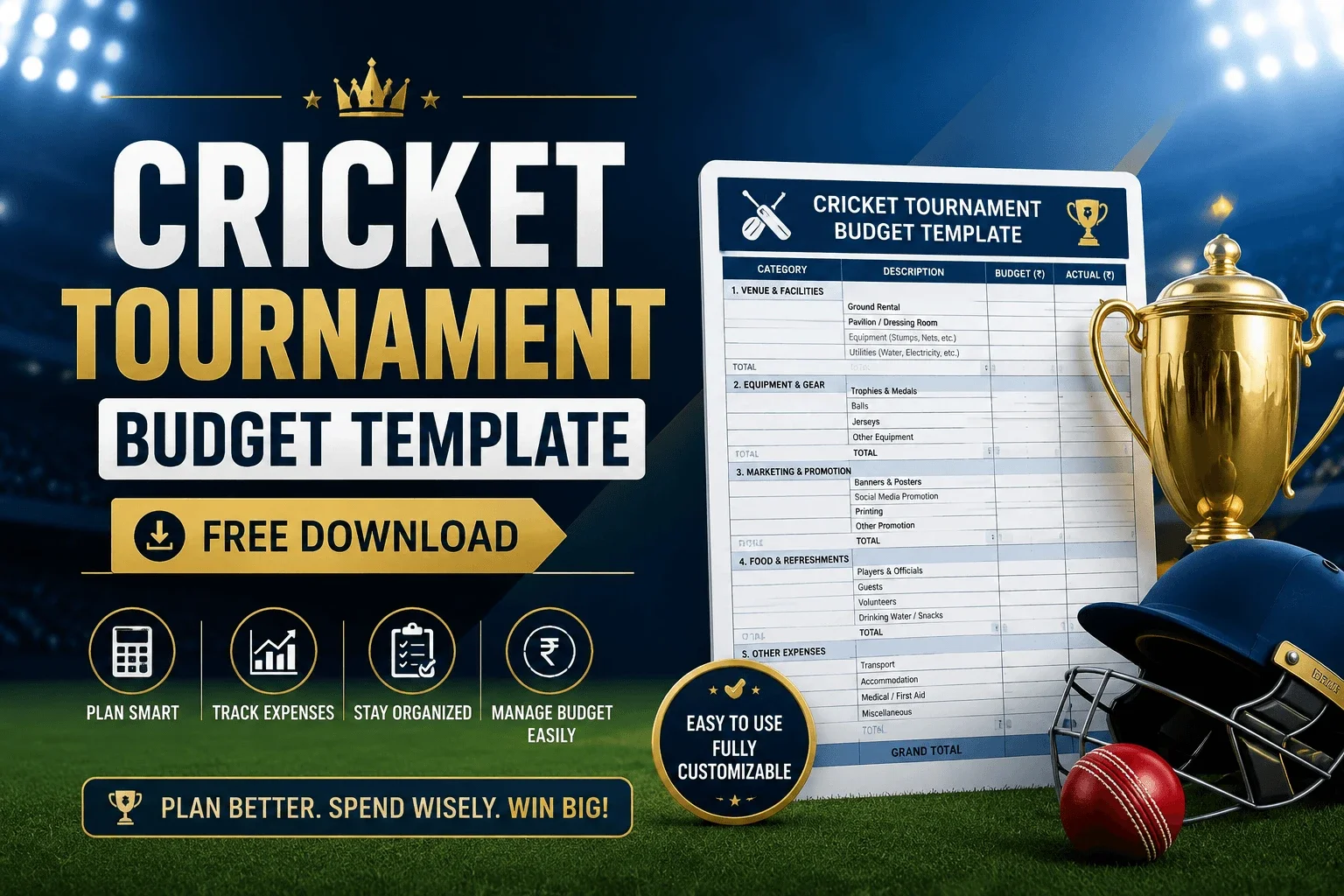
Download our free Cricket Tournament Budget Template to plan and manage all expenses — venue, equipment, umpires, prizes, catering & more. Easy to customize for any tournament size.
Cricket Tournament Budget Template — Plan Every Rupee, Win Every Match
Running a cricket tournament without a budget plan is like batting without a strategy — you'll get out early and regret it. Whether you're organising a local box cricket league in Surat, a club-level T20 knockout, or a full district-level championship, this complete cricket tournament budget template will help you plan, track, and manage every expense from day one. No surprises. No last-minute fund crunches.
Why Budget Planning is Critical for Every Cricket Tournament
Most local cricket tournaments in India fail not because of poor cricketing talent — but because of poor financial planning. You book the ground, print jerseys, arrange trophies, and then realise you've run out of money before buying stumps or setting up a scoreboard. Sound familiar?
A proper cricket tournament budget template solves exactly this problem. It gives you a bird's eye view of every single expense and income source before you spend even one rupee.
- Prevents unexpected financial shortfalls mid-tournament
- Helps you attract sponsors by showing professionalism
- Makes team entry fee calculation accurate and fair
- Creates accountability among your organising committee
- Allows you to plan contingencies for rain, injuries, or delays
"A tournament that's professionally planned on paper always runs smoother on the ground — and sponsors notice that."
— Experienced Cricket Organiser, GujaratAll Budget Categories Explained
Every cricket tournament budget, whether it's a small 8-team local league or a 32-team knockout, falls into these core spending categories. Understanding each one prevents blind spots in your planning.
Ground booking charges, pitch preparation, boundary ropes, sight screens, seating or tent arrangements, and security deposit.
Cricket balls (match + practice), stumps and bails, batting pads, helmets, gloves (if club provides), score sheets, and umpire equipment.
Team jerseys (if organiser provides), umpire uniforms, tournament banners and flex boards, branding at venue, and trophy table setup.
Winner trophy, runner-up trophy, Man of the Match awards, Best Batsman / Bowler / Fielder prizes, cash prizes if applicable, and medals for all participants.
Social media promotions, WhatsApp broadcast charges, photography / videography, live streaming setup, and scoreboard display (physical or digital).
Water and refreshments for players, lunch or snack arrangement on match days, hospitality for chief guests, umpires, and sponsors.
Scorers' fees, umpire fees, transport reimbursements, printing costs for schedules and ID cards, first-aid kit, and contingency buffer (always keep 10–15%).
Always create a contingency line item of at least 10% of your total budget. Rain delays, last-minute ball replacements, or extra match days will always cost you something unexpected.
Ready-to-Use Cricket Tournament Budget Template
Use this as your starting reference. Adjust figures based on your city, tournament size, and number of teams. This template covers a mid-size 16-team T20 tournament as a base example.
| Category | Item | Estimated Cost (₹) | Notes |
|---|---|---|---|
| Venue | Ground booking (5 days) | ₹15,000 – ₹50,000 | Municipal vs private |
| Venue | Pitch preparation | ₹2,000 – ₹8,000 | Per day cost |
| Equipment | Match balls (SG/Cosco) | ₹4,000 – ₹12,000 | 2 balls per match |
| Equipment | Stumps, bails, boundary | ₹3,000 – ₹6,000 | One-time or rent |
| Prizes | Winner trophy + cash | ₹5,000 – ₹25,000 | Depends on scale |
| Prizes | Individual awards | ₹2,000 – ₹6,000 | Best player awards |
| Jerseys | Banners + flex boards | ₹3,000 – ₹10,000 | Sponsor visibility |
| Marketing | Photography/video | ₹2,000 – ₹8,000 | Per event day |
| Officials | Umpire fees | ₹500 – ₹1,500/day | 2 umpires + scorer |
| Food | Player refreshments | ₹3,000 – ₹8,000 | Per match day |
| Admin | Printing, ID cards | ₹1,000 – ₹3,000 | Registration docs |
| Contingency | Buffer (10–15%) | ₹5,000 – ₹15,000 | Rain/emergency |
For a standard 16-team T20 tournament spanning 5 match days, total expenses typically range from ₹55,000 to ₹1,60,000 depending on city, prize pool, and whether jerseys are included. Entry fees from 16 teams at ₹4,000 each = ₹64,000 — meaning you often need sponsorship to cover the gap.
Income & Sponsorship Sources to Cover Your Budget
A smart organiser never relies on one income stream. Here are the most common ways local cricket tournaments fund themselves:
- Team Entry Fees — Most reliable source. ₹2,000 to ₹8,000 per team based on format and prizes.
- Title Sponsorship — A local business, shop, or brand pays to get their name on the tournament banner and jerseys.
- Jersey Sponsorship — Each team's jersey carries a sponsor logo, and sponsors pay per team.
- Ground Hoardings — Sell boundary board space to local advertisers at ₹500–₹2,000 per board.
- Food/Beverage Stalls — A canteen at the ground creates income while serving players and spectators.
- Live Stream Donations — Viewers watching online can be encouraged to donate via UPI during the stream.
- Player Auction Fees — If you run an IPL-style auction, charge team owners a registration fee of ₹500–₹2,000.
Total Income (Entry Fees + Sponsorships + Other) must be ≥ Total Expenses + 10% Contingency. If your income falls short, either reduce the prize pool, cut catering costs, or increase entry fees before confirming the tournament.
Budget Mistakes Most Local Organisers Make
Even experienced cricket organisers make these financial errors. Learn from them so you don't repeat them.
A single match can use 2–3 balls. In a 15-match tournament, you're looking at 30–45 balls. At ₹300–₹500 each, that's ₹9,000–₹22,500 on balls alone. Most organisers budget for 10 and run out.
Umpires need to be paid for every match day — not just the final. 2 umpires + 1 scorer for 5 days = a meaningful cost. Always include this in your draft budget from day one.
Announcing a ₹50,000 cash prize to attract teams when you only have ₹30,000 in entry fees and no confirmed sponsor is one of the fastest ways to damage your reputation as an organiser.
Extra match days mean extra ground cost, more balls used, and more food required. A 10–15% contingency fund is not optional — it's essential for any outdoor cricket event in India.
Planning Team Auction Budgets in IPL-Style Cricket Tournaments
If you're running an IPL-style auction tournament, your budget template needs an additional layer — each team owner gets a "purse" to bid for players. Getting this right is critical for a fair and exciting auction.
How to Set Team Purses
- Decide total player pool size (e.g. 120 players for 8 teams of 15)
- Set a base purse for each team — typically ₹50,000 to ₹5,00,000 depending on your league scale
- Define player base prices in tiers: Elite (₹10,000+), Mid (₹3,000–₹8,000), Base (₹500–₹2,000)
- Each team must spend at least 70% of purse to ensure active bidding
- Use auction software (like CricAuction.live) to track live balances automatically
CricAuction.live automatically tracks every team's remaining balance in real time during the auction — no manual spreadsheet errors, no disputes. Team owners see their balance on screen as every player is sold.
Step-by-Step Budget Planning Guide for Cricket Tournament Organisers
Follow these steps in sequence every time you start planning a new tournament. This order ensures you never miss a critical expense.
Define Tournament Format First
League, knockout, or combo? Number of teams? Days of play? Each decision directly impacts your cost structure before you write a single number.
List All Expense Categories
Use the full category list above — venue, equipment, prizes, jerseys, officials, food, marketing, admin, contingency. Don't skip any category even if the current estimate is zero.
Get Real Quotes, Not Guesses
Call your ground, ask a trophy supplier, check ball prices. Real quotes give you a defensible budget instead of wishful thinking numbers.
Calculate Minimum Entry Fee from Total Cost
Total Expenses ÷ Number of Teams = Minimum entry fee to break even. Add 15–20% for contingency and you have your entry fee range.
Identify Sponsorship Gaps
Subtract entry fee income from total expenses. The remaining gap = how much sponsorship you need. Create your sponsorship proposal around this number.
Lock the Budget Before Announcing
Never announce prizes, entry fees, or team counts publicly until your budget is locked and at least 50% of income is confirmed. This protects your credibility.
The best cricket organisers treat budget planning like a match strategy — they prepare for the best case, plan for the worst case, and always keep a reserve for the unexpected. A budget template is your financial game plan.
A cricket tournament budget template isn't just a spreadsheet — it's the difference between a tournament people remember fondly and one that ends in disputes and disappointment. Use this template as your financial blueprint every single time.
- Cover all 12 budget categories — venue, equipment, prizes, jerseys, officials, food, marketing, admin & more
- Always keep 10–15% as contingency — outdoor cricket in India always has surprises
- Calculate entry fees from real expenses, not guesswork
- Identify your sponsorship gap before reaching out to sponsors
- Lock the budget before announcing the tournament publicly
- Use CricAuction.live to manage player auction budgets in real-time during IPL-style leagues